
Culver City Directory Holdings
Old telephone books hold a surprising amount of Culver City life. Digitized Los Angeles-area scans, Library of Congress phone volumes, library microfilm, and local historical shelves each capture a different slice, often listing an address, occupation, spouse, business, or telephone exchange. Keep the original spelling. Compare nearby editions, and check findings against census or parcel evidence before trusting them. A Culver City city directory search bridges the gap when a census year leaves too much space, helping with family and house history, though these entries never form complete resident rolls. You can also find who lives on a street in Culver City by searching names, streets, or household records through the same sources.
| Collection | Years | Where Held | Access |
|---|---|---|---|
| Culver City white and yellow pages | Jan. 1935-Jun. 1945 | Library of Congress | Free images, OCR, IIIF, downloads |
| Los Angeles area city and street directories | 1875-1987 overall | Los Angeles Public Library digital collection | Free keyword and page browse |
| Historic city, business, and phone directories | 1873-1970 | LAPL ResCarta | Free scans and OCR search |
| Los Angeles city directories | 1873-1942 | LAPL Central paper and microfilm | In-library reference access |
| U.S. city-directory microfilm | 1861-1960 | LAPL Central | In library, more than 5,000 rolls |
| Culver City phone books and yearbooks | Various decades; run unpublished | Culver City Historical Society | Contact archive staff |
| California census schedules and local history | 1850-1910 | LA County Library Californiana, Norwalk | Closed-stack access |
The listed dates are not a promise of an unbroken annual series. No authoritative online catalog pins down the exact Culver City Polk publisher runs. The same goes for every reverse-directory inclusion. The last standalone printed year and all missing volumes are equally open questions. Publishers drew territory their own way. A household may sit under Culver City, Palms, or a broader Los Angeles West or Mid-Cities heading rather than the incorporated boundary.
The municipal shelf is a different animal. Culver City's City Clerk keeps agendas, minutes, ordinances, elections, legal notices, and other city records. It holds no county deed index or state vital copies. Find the office at 9770 Culver Boulevard, first floor; it lists 310-253-5851 and city.clerk@culvercity.org. Directory-adjacent permit or legislative files can be requested through the city's public-records process.
Culver City Directories Online
Start any remote search at Los Angeles Public Library's digital city and street directory collection. Its overall Los Angeles-area span runs 1875 to 1987. The historic city, business, and phone directory material in ResCarta reaches 1873 to 1970. The scans work with keyword search or page-by-page browsing. Try likely spelling variants of a name. Then save the page number and exact heading. OCR can flatten columns or misread a street abbreviation. LAPL's digitized city and street directories open the collection entry point. Use them for Culver City city directory research.
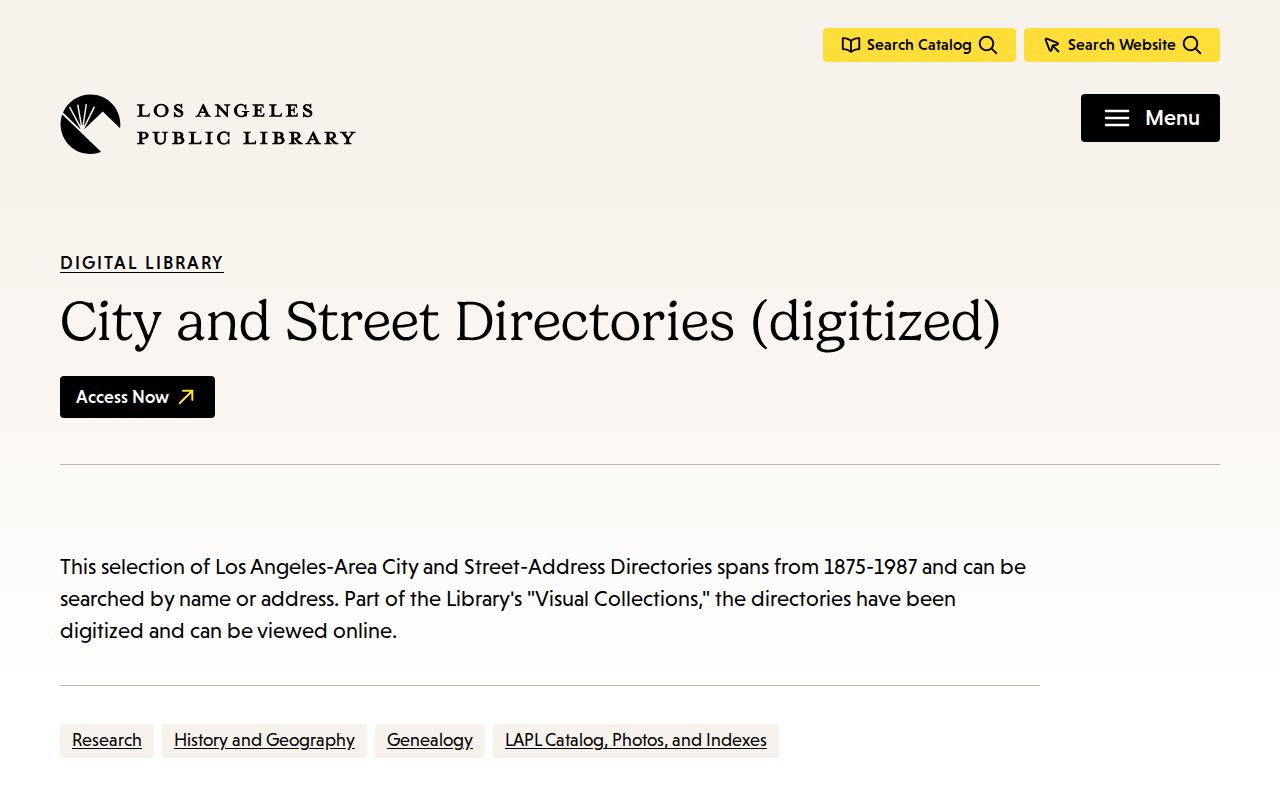
The collection page links the broad year span to the scan browser. A result still needs a check against the page image, since an OCR hit is a lead rather than a clean transcription.
Culver City ResCarta Search Clues
ResCarta earns its keep when a name search stalls. Residential entries often place h before a householder address or r before a residence. So a query like h443 N Av 52 can succeed where a bare number fails. Addresses also print in several forms. Numbered avenues appear as Ave 64 or "Avenue Sixty-Four," and "Bway" can stand for Broadway. The LAPL ResCarta directory browser is the direct route for these older Culver City city directory searches. It delivers both scan images and OCR.
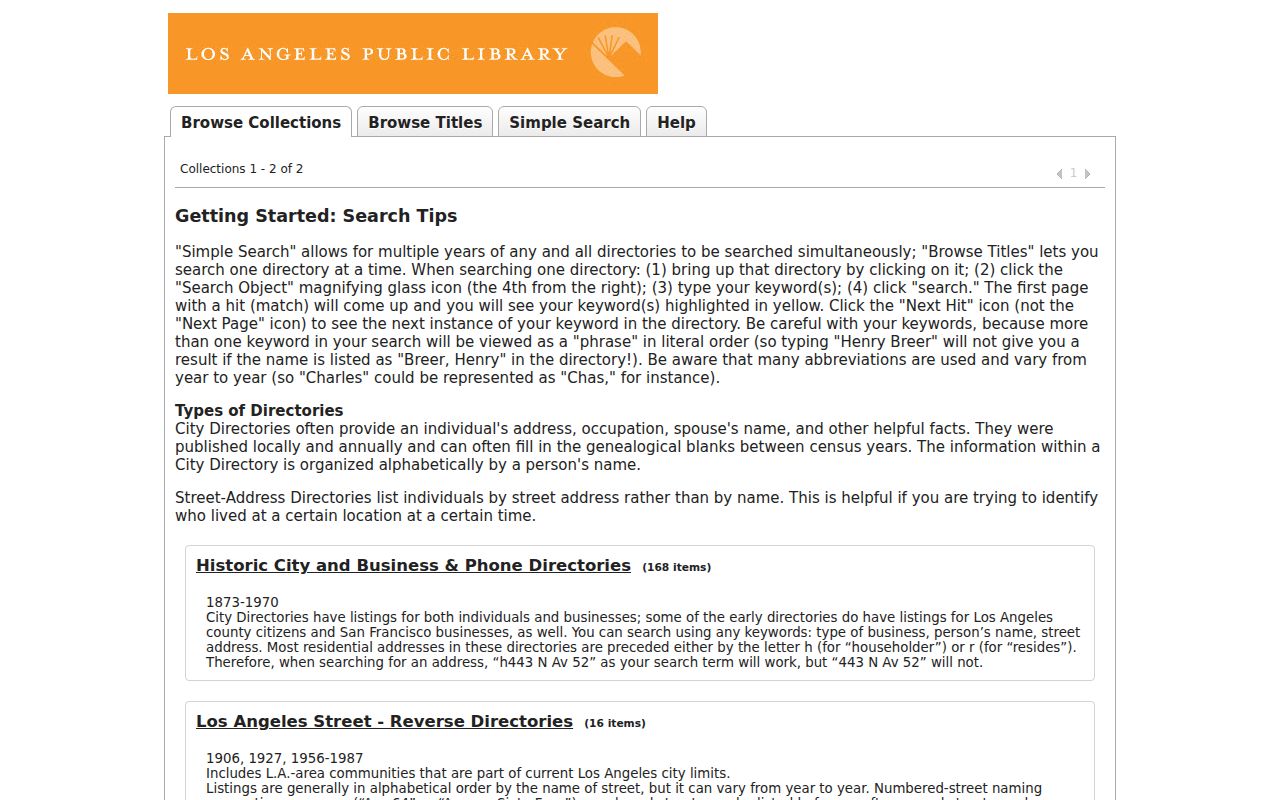
When OCR misses a street, browse the alphabetical street section directly. Also try the locality headings Culver City, Palms, and the broader Los Angeles West or Mid-Cities volumes.
Reading a Culver City Directory
A verified Culver City-Palms telephone entry reads as a compact trail from person to place. The alphabetical line usually gives a surname, given name or initials, an r residence mark, house number, street, locality, and the Culver City exchange telephone number. Business lines lead with the business name. From there they add the address, telephone number, and sometimes an advertisement cross-reference. Capture each line exactly as printed before expanding any abbreviation.
| Name | Surname followed by given name or initials; retain spelling and punctuation. |
|---|---|
| Occupation or business | Work description or business name when the entry supplies one. |
| Spouse or family note | Record a spouse or relationship note when a volume includes it; the sampled phone page centers on name and address. |
| Residence mark | r signals resides in the sampled pattern; it does not prove title or legal occupancy. |
| Householder mark | h often marks a householder in LAPL reverse-directory OCR; check that volume's key. |
| Street and locality | House number, street, and a heading such as Culver City or Palms. |
| Exchange and phone | The local telephone exchange and number connect the entry to its publication year. |
| Occupancy mark | No consistent occupancy mark was verified in the local sample, so do not infer it. |
- Criss-cross directory
- A street-order or reverse section that starts with an address and points to a named person or business.
- Householder index
- An address or household reference that helps find the person listed as the main householder.
- Abbreviation key
- The volume's legend for short street and role marks; read it before treating an OCR hit as a fact.
- Residence mark
- A printed
ror related mark indicates a directory association, not a complete resident roll.
A Culver City directory entry is a snapshot from one dated publication, nothing more. Treat each field as a clue rather than proof, because a household the city directory left out could still have occupied that very address.
Culver City Palms Telephone Run
The strongest verified local phone set is the Library of Congress item California White Pages and Yellow Pages, Culver City, covering January 1935 through June 1945. Its pages use the combined Culver City and Palms exchange heading. A personal line brings together a surname, given name or initials, an r residence mark, house number, street, locality, and telephone exchange. Business lines add a business name, address, phone number, and sometimes an advertisement cross-reference.
The run works in both directions. A surname can lead to an address. A known street can reveal a listed subscriber. Remember it is a publication snapshot, not a complete resident roll, since people without listed telephone service, nonsubscribers, and unlisted households all go missing. The Palms heading also shows why a narrow search for the words "Culver City" can skip a useful page.
Culver City Directory at Julian Dixon Library
One strong stop exists for a missing Culver City directory year. It is LAPL Central's History and Genealogy Department. Its shelves hold about 52,000 genealogy titles. The department also keeps more than 5,000 U.S. city-directory microfilm rolls spanning 1861-1960, plus roughly 1,000 hard-copy directories. Los Angeles volumes from 1873-1942 sit there on paper or film. Digital scans sometimes skip a year. They also bury a Culver City entry inside a wider Los Angeles volume, so a librarian's eyes still earn their keep.
The Julian Dixon Library local-history listing points Culver City researchers to the County of Los Angeles Library branch. It also covers the branch's digital resources.
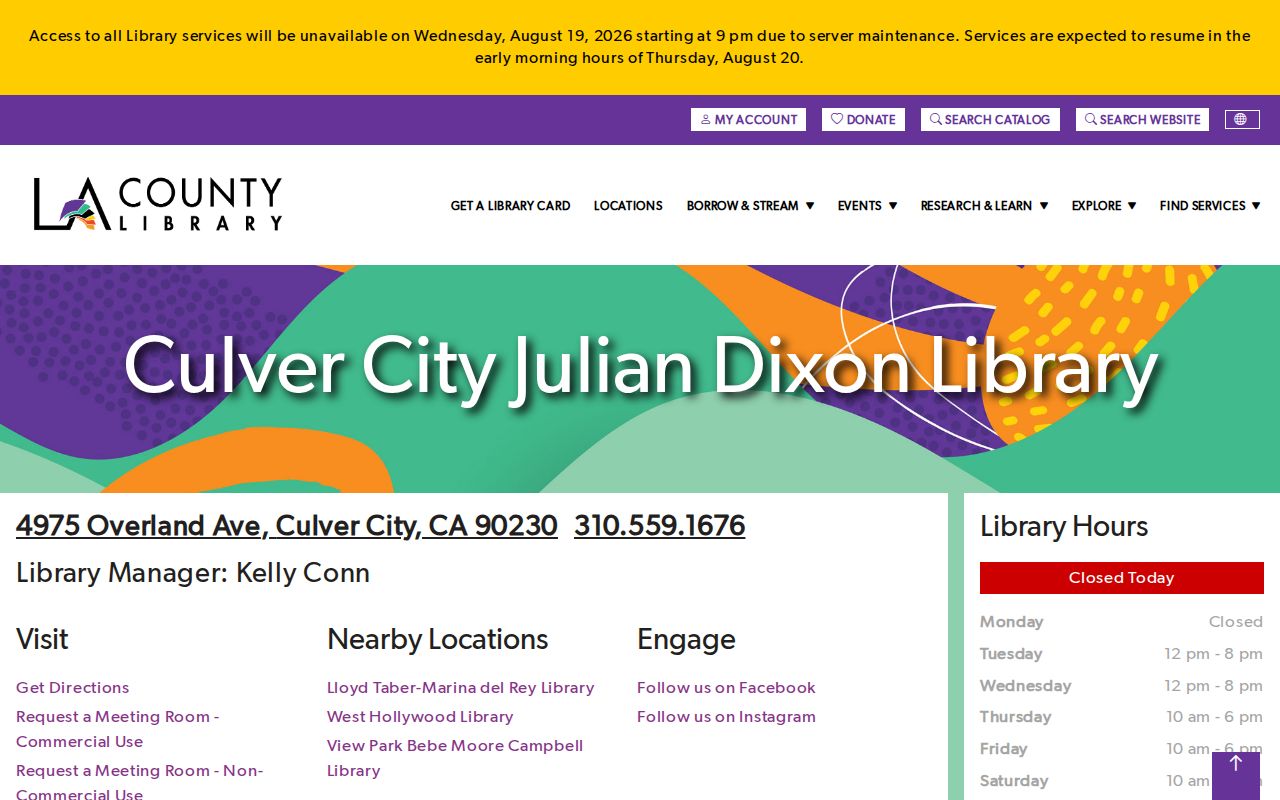
The Julian Dixon branch has deep roots. It opened inside a Pacific Electric depot on April 1, 1915. That was before Culver City even incorporated. The branch has stood at its current location since 1970. The branch's databases, Digital Collections, and Judaica Collection can flesh out a name. Pull one from an old city directory.
For heavier California material, look farther afield. The County of Los Angeles Library's Californiana Collection in Norlake sits at a distance. It counts more than 24,000 books. It also holds over 200 periodical and newspaper titles, California census schedules from 1850-1910, the Los Angeles Star from 1851-1879, nineteenth-century directories, and shelf after shelf of local histories.
Culver City Historical Society Directories
The Culver City Historical Society has collected since 1980. Its holdings include photographs, maps, and newsletters. They also cover civic memorabilia, film and MGM material, school yearbooks, and local phone directories. For a Culver City city directory year that falls outside the online LAPL span, the society is a useful fallback. The 2025 newsletter asks for local phone directories from any decade. It also seeks junior and senior high-school yearbooks. That confirms the collecting interest. It does not prove any particular year is held. The Culver City Historical Society archive contact is the right route for a holdings question. Use it for any residents directory material query.
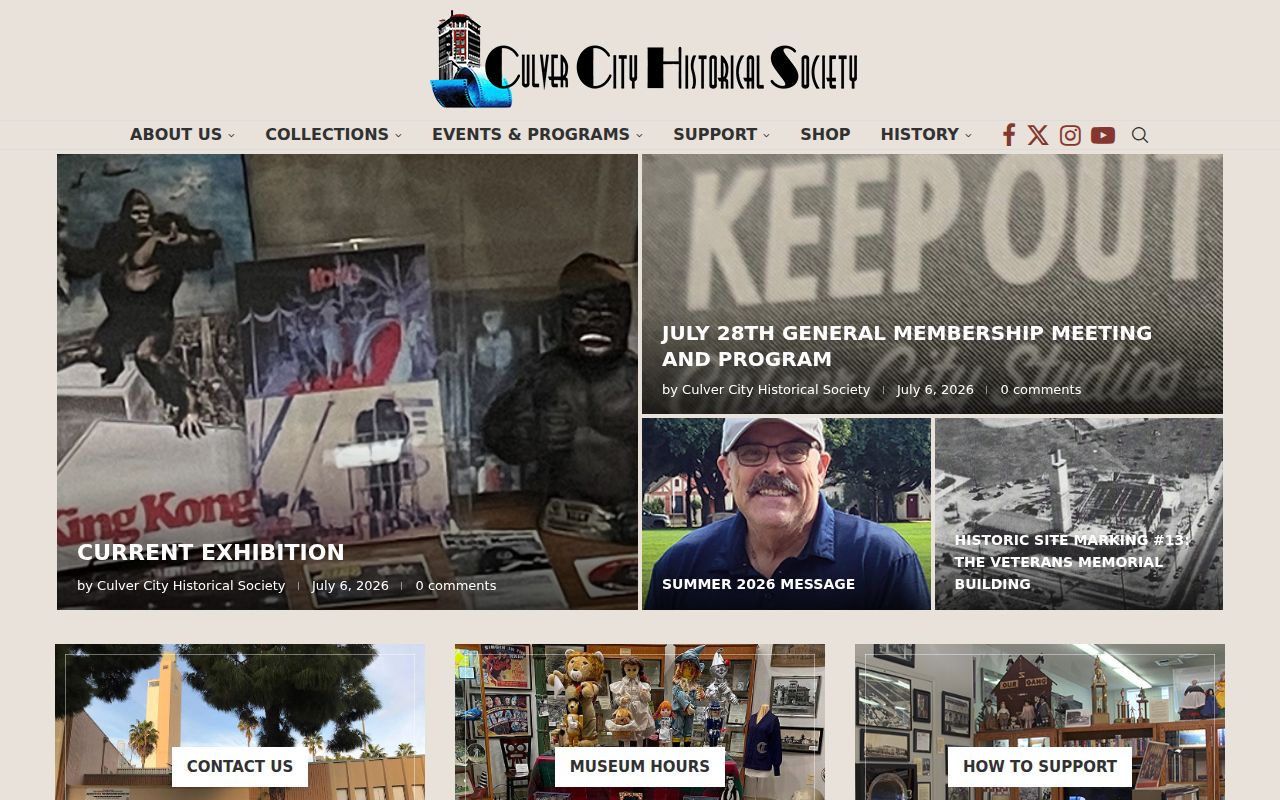
The contact details are P.O. Box 1356, Culver City, California 90232, info@CulverCityHistoricalSociety.org, and 310-253-6941. Archive references place the resource center at the Veterans Memorial Building, 4117 Overland Avenue. Confirm appointment and museum hours before any visit.
Trace Culver City Directory Households
A household trail needs more than a single annual hit. Keep the printed name, address, exchange, occupation, spouse note, and directory heading. Then set that address beside a census household. The 1950 federal census is the newest schedule opened under the 72-year rule. The National Archives census guidance explains the release framework. It also routes older schedules through library and archive access.
- Search surname variants in the alphabetical section and save the first plausible entry.
- Check the next and prior edition, recording every move, changed initial, spouse note, and exchange.
- Switch to the reverse or criss-cross section when the address is known, trying both
handr. - Pair the 1935-1945 phone run and nearby LAPL editions with the 1940 and 1950 census households.
- Add deeds for owner chronology and permits for building change, then use probate, newspapers, or cemetery records as corroboration.
A missing name in a Culver City directory can mean many things. Someone may have moved, died, or asked to keep the line unlisted. OCR errors and volume gaps cause plenty of blanks too. So directory evidence proves association during a publication year, never legal occupancy of an address.
Want a fuller picture of who lives on a block now? Turn to the Culver City street directory. It pulls together address-keyed records.
Culver City Directory Timeline
Culver City's record story has a long library spine and a newer digital edge. The timeline below keeps two threads apart: the span of city directory coverage, and the local institutions that preserve or explain those records.
| 1873-1942 | LAPL Los Angeles city directories appear in paper and microfilm holdings. |
|---|---|
| 1875-1987 | LAPL's wider digital city and street directory environment spans the listed Los Angeles-area years. |
| April 1, 1915 | The library opens in a Pacific Electric depot, two years before incorporation. |
| 1935-1945 | The verified Library of Congress Culver City and Palms telephone run fills a local bridge. |
| 1980 | The Culver City Historical Society forms and later collects phone books and yearbooks. |
| 2024-2025 | City permit and planning digitization expands adjacent address research, though it does not create a directory run. |
No earliest surviving municipal minute-book identifier survives in memory here. No complete first or last standalone Culver City city directory is known. Local record losses went unrecorded as well. Resist the urge to invent a courthouse-fire story. Doing so would only fill those gaps with fiction.